The system / one product, three tiers
Sheet 01 / 10
The whole machine, documented and yours to run.
The production system behind one person shipping two quality long-form videos a week — every stage, spec, checklist, and guardrail. Taught as a course, shipped as a working app, complete at purchase.
Founder pre-order opens before launch — 20% off every tier, and the list gets first access.
The problem
Sheet 02 / 10
You already know the math.
A quality long-form video costs a week of evenings when you do everything yourself. So one person gets to pick two of three: quality, cadence, a life.
The usual answers don't fix the math. Hiring an editor moves the cost, not the work. "AI automation" churns out videos no one finishes watching. And doing less means the channel stalls.
This system is the third option: keep the judgment, hand off the labor. One operator runs a machine that researches, drafts, fact-checks, narrates, illustrates, and renders — and every decision that matters still stops at a human gate. It isn't a theory. It's the working pipeline behind a real channel, on the record.
01 / What it is
Sheet 03 / 10
An engine and a cockpit.
The system is two halves. The engine is a set of command specs — precise operating manuals an AI coding agent executes stage by stage. The cockpit is an app that runs entirely on your machine: your scripts, research, thumbnails, beat plans, and analytics, with a review surface for every approval. The engine does the labor. The cockpit is where you keep the judgment.
-
01
Research.
Outlier discovery across YouTube — reach, audience, and recency filters find the videos worth learning from, in your niche and in neighboring ones worth borrowing formats from.
-
02
Scripting.
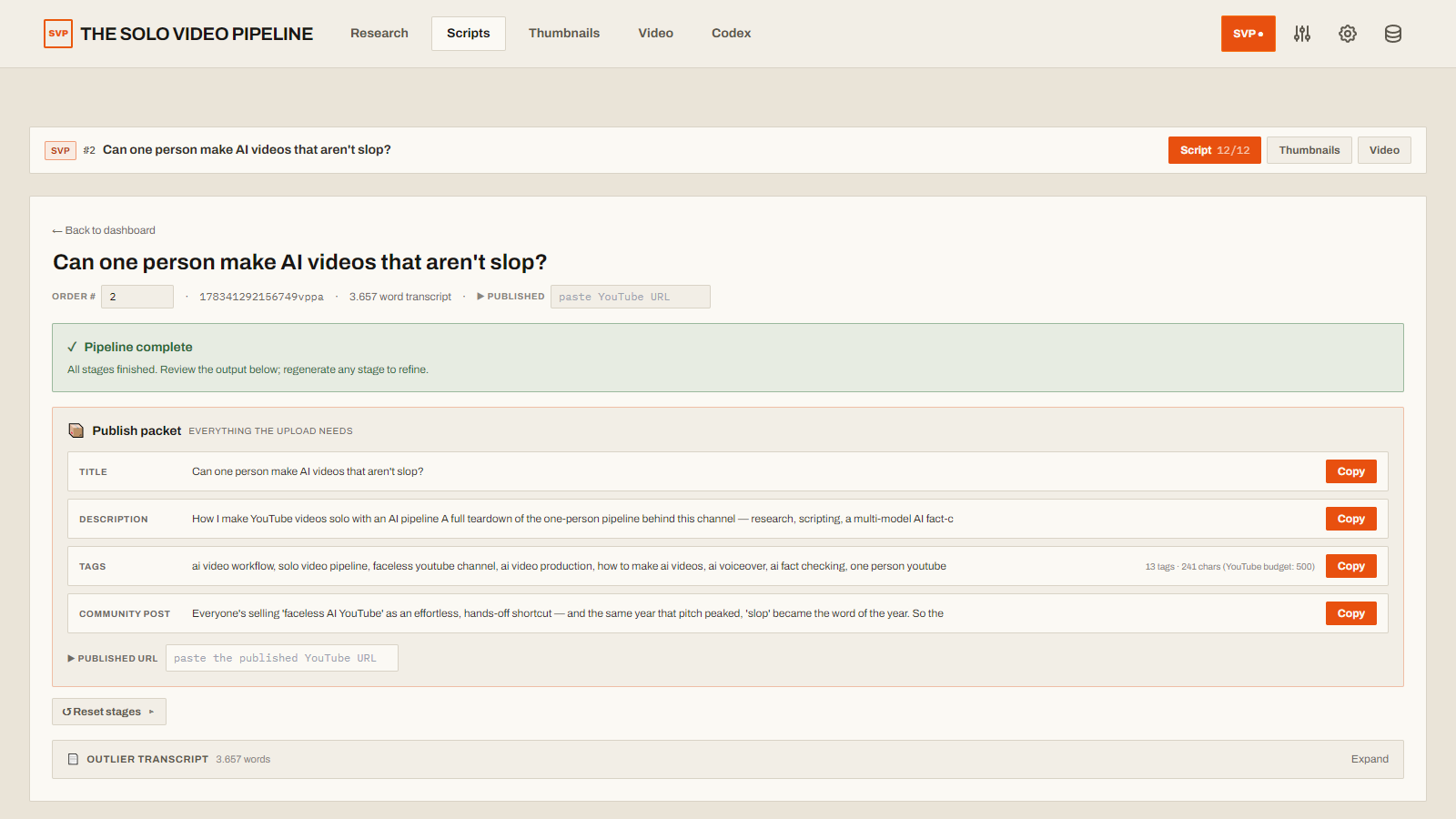
A twelve-stage pipeline from seed to publish-ready script. Five entry modes — remix an outlier, brief a topic, dump loose ideas, chase a keyword, answer your audience. Research run from several angles in parallel, an outline attacked by a blind critic, five intro candidates, body, polish, title, description.
-
03
Fact-checking.
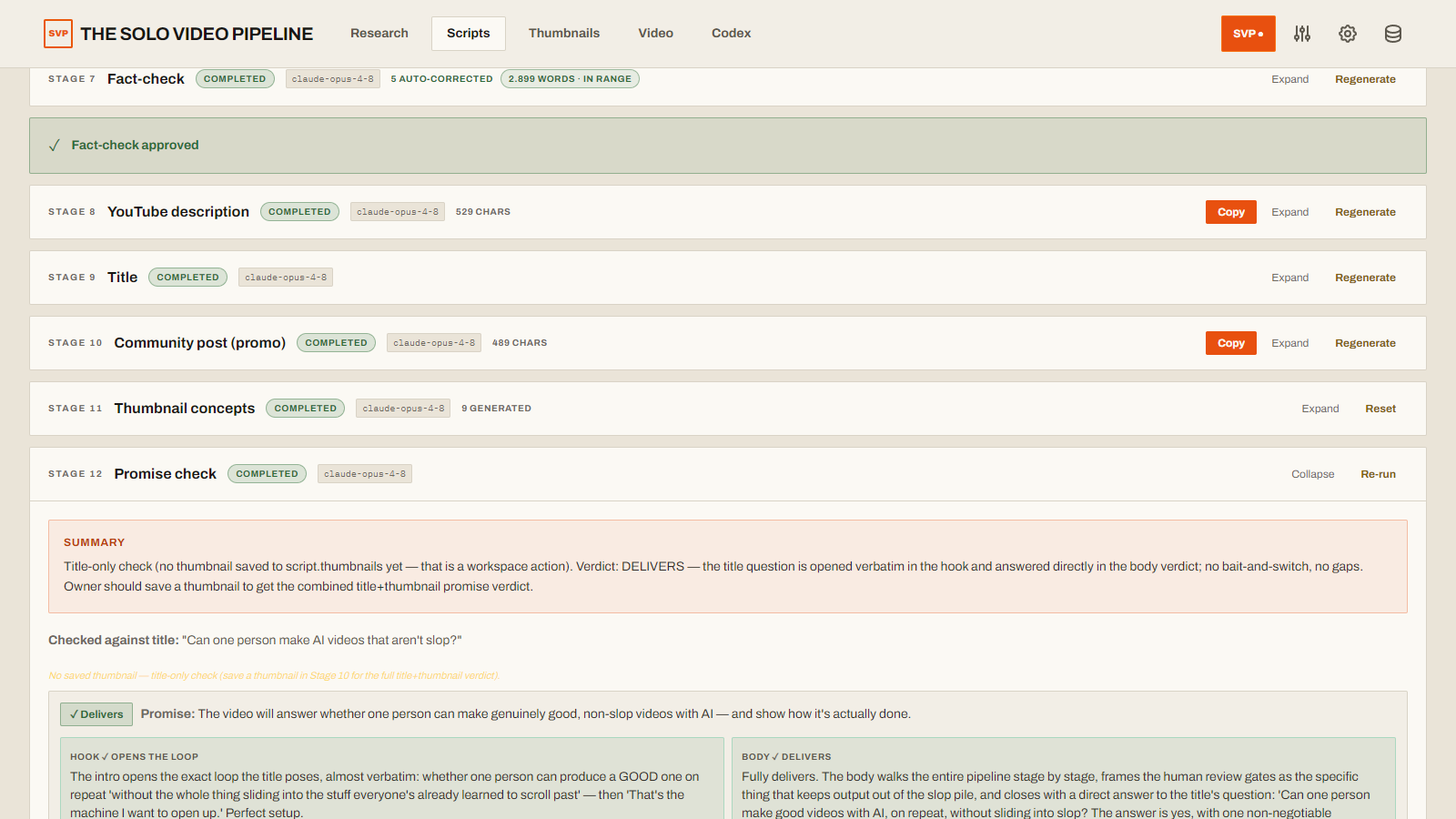
Every claim goes through multiple independent AI checkers — blind to each other, drawn from different model families, some web-grounded and some not. Verified claims become citations with sources; anything uncertain is flagged. A hard approval gate: nothing ships until you sign off.
-
04
Voice.
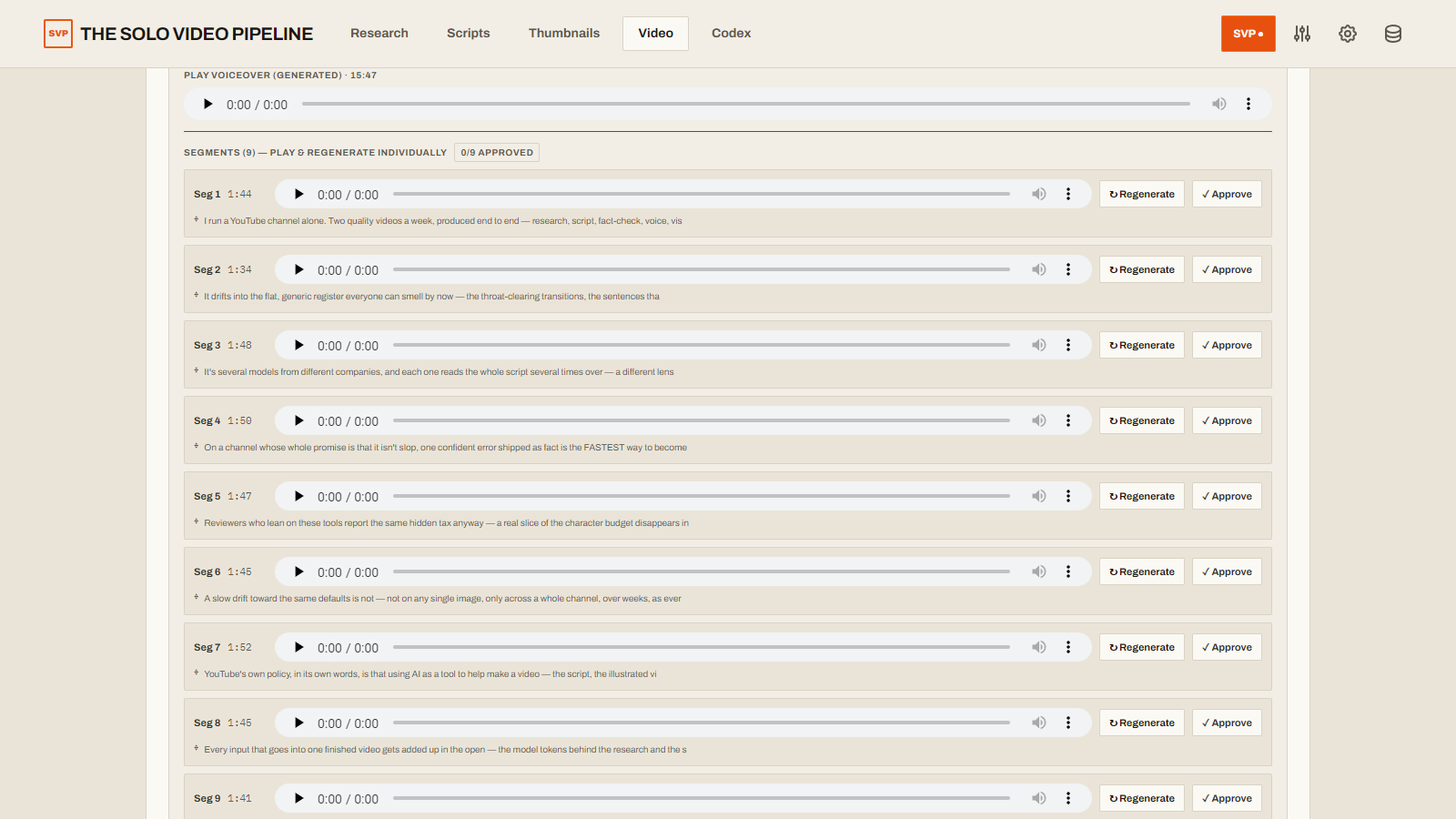
Voice-clone narration, generated in segments. Re-roll any segment without paying for the rest, automatic loudness leveling, and a word-level transcript that times everything downstream. Your own recorded audio works too.
-
05
Visuals.
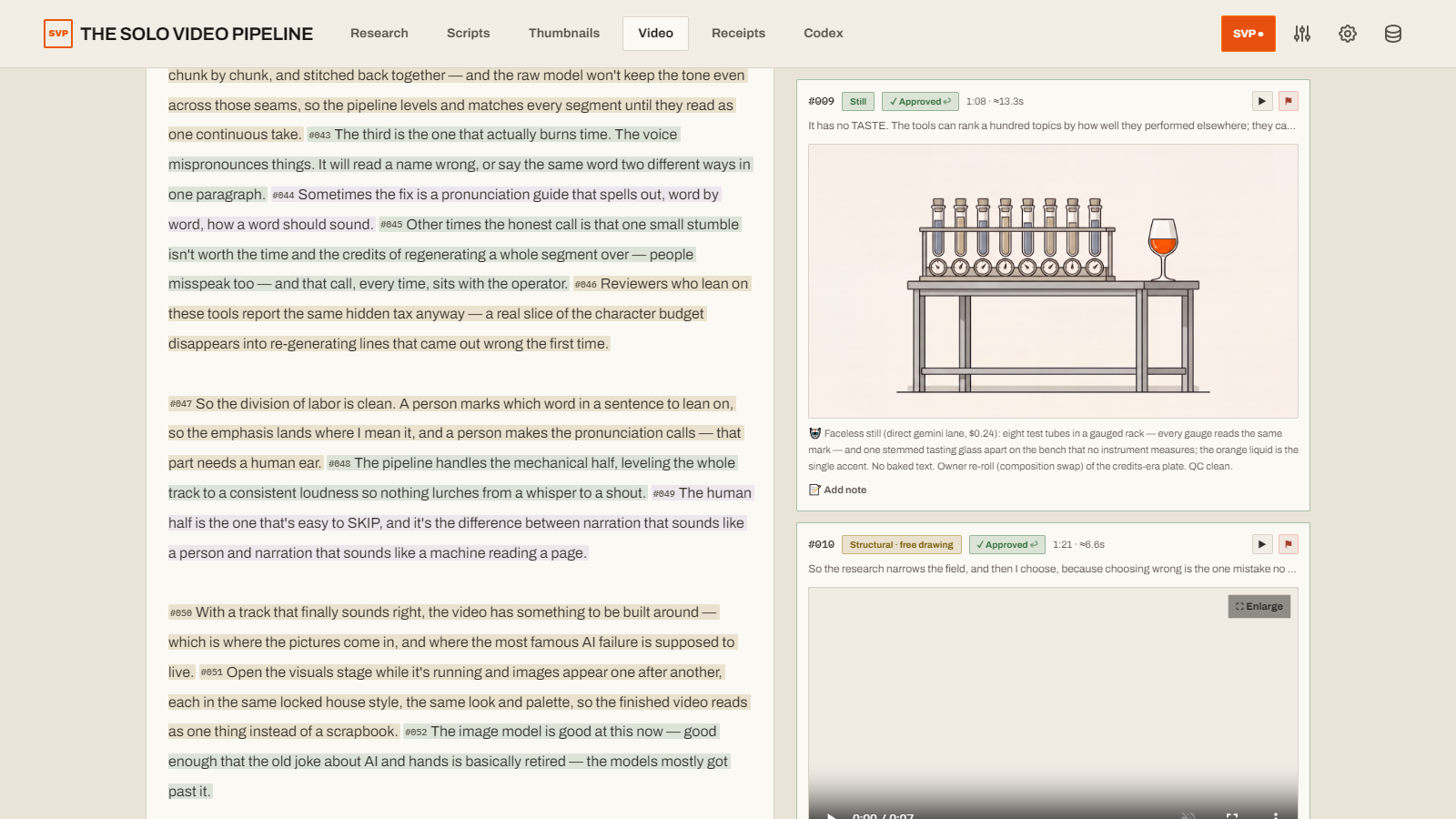
A beat board proposes the visual plan; you review and lock it. Then the system renders 4K stills from locked style anchors — one artist's look, every video — plus diagrams and charts drawn in your brand and real screen captures with highlights timed to the narration.
-
06
Assembly.
The pipeline cuts the video itself: frame-exact 24fps assembly, hard cuts on the beat grid, mastered loudness. There is no timeline and no editing weekend — the render is the edit.
-
07
Analytics.
Read-only analytics on your own channel: retention curves, reach-normalized anomaly flags, subscriber yield, and a written channel digest that flags every notable video. The findings steer the next round of research and scripting.
02 / The receipts
Sheet 04 / 10
Not renders of an idea. Screenshots of the machine.
Everything below is the actual app, photographed on the real published video's script — not a staged demo. The same cockpit ships to you — same stages, same gates, same guardrails — set up for your channel instead of mine.
03 / Why it holds
Sheet 05 / 10
The disciplines that keep it honest.
Anyone can chain AI calls together. What makes this system sellable is the set of rules wrapped around them — each one built in from the start so a whole class of incident never gets a chance on a real channel.
Discipline 01
Human gates everywhere.
Every stage that spends money or shapes the video pauses for an explicit human pick: the angle, the fact-check, the title, the thumbnail, the locked beat plan. There is no way to skip you.
Discipline 02
Spend governance.
For visuals: exact prices verified against a maintained price table before anything runs, a ledger entry written before every paid call — so a crash can never produce untracked spend — hard per-video budget caps, and one paid generation per image. Voice and model usage run under hard caps and quota pre-flights. The system never quietly retries with your money.
Discipline 03
Verification before volume.
The fact-check matrix treats every claim as unproven until independent checkers agree — and disagreements surface to you instead of shipping. Quality is a checklist, and the checklist is in the box.
Discipline 04
A consistent brand, mechanically.
Locked style anchors and character references keep every image in one visual language and any recurring character on-model shot to shot — the difference between a channel and a content feed.
Discipline 05
Local-first and private.
The app binds to your machine only. All data lives in a local database you can back up as a file. The only outbound calls are to the AI and platform APIs you configure with your own keys.
Discipline 06
Nothing proprietary holding you hostage.
The pipeline is plain-text specs plus a plain local API. Anything that can read a file and make HTTP calls can run it — you are never locked into a vendor, including this one.
04 / What ships
Sheet 06 / 10
Everything you get, tier by tier.
One product, three depths. Every tier is complete at purchase — you buy it once and it's yours. Higher tiers contain everything below them. Nothing is purchasable yet.
Tier 01
The method.
The full system, taught as a recorded course — being produced now, by the pipeline it teaches.
- Every stage end to end: research, scripting, fact-checking, voice, visuals, assembly, analytics.
- The tech, explained from zero — the terminal, Node, API keys, the agent: what each piece is and how it fits. No developer background assumed.
- The real specs, checklists, and cost sheets — recorded on screen as they run in the live system.
- The quality disciplines: gates, spend rules, and how to keep them.
After the course, you understand the machine deeply enough to build your own version of it — your stages, your gates, your own AI agents doing the build work. Skipping that build is what tier 02 is for.
Tier 02
The method + the machine.
Everything in tier 01, plus the complete app as a dated snapshot for you to run.
- Everything in tier 01.
- The complete app — the cockpit you saw above, as a dated edition snapshot.
- The command specs for every stage — the operating manuals the agent runs, ready for your own Claude Code.
- The working files: the channel profile template, style and character references, quality checklists, spend rules and caps, prompt libraries.
- Bring your own API keys, run the setup for your channel, and get started right away.
After setup, you produce with the same machine the channel runs — your channel, your keys, your machine.
Tier 03
The founding operator.
Everything in tier 02, plus a bounded start with me directly.
- Everything in tier 02.
- One onboarding call — your machine, your channel, the system running.
- 30 days of direct support while you get up to speed.
- The window opens at launch, not at purchase — your 30 days start when the polished edition lands.
The point is a bounded start, not a dependency — one month in, you run it alone by design.
05 / What you need
Sheet 07 / 10
Bring four things.
-
01
A computer you control.
The system runs locally — a local app, a local database, no hosted service, no login. It's built, run, and verified daily on Windows; the honest word on other platforms is in the FAQ below.
-
02
A Claude Code subscription.
The AI agent that executes the command specs. The system is built and verified on Claude Code; the specs are plain markdown with an adaptation guide, so other capable agents can be wired up — without the same guarantee.
-
03
Your own API keys.
Voice, images, models, YouTube — you bring your own keys and pay providers directly for what you use, governed by the spend disciplines above.
-
04
Judgment, twice a week.
You review the angle, the facts, the title, the plan. That is the job — and it fits around a life.
No developer background required. Setting up the shipped machine starts from a blank computer: installing the tools, creating the keys, running the first session — by checklist, not by writing code.
06 / What it is not
Sheet 08 / 10
What it is not.
- 01No community.
- 02No done-for-you — you run it, always.
- 03No SaaS, no login — you run it yourself locally.
- 04No subscriptions, no standing obligations — complete at purchase.
- 05No open-ended coaching — tier 03's direct support ends as soon as the 30 days have passed.
- 06No auto-posting — the system never writes to your channel; you press upload.
- 07No income promises — capability claims only, with receipts.
You buy it once, it's complete at purchase, and it's yours. On the system tiers — 02 and 03 — that means the whole machine: the app and its working files, ready to run from a clean start on your own machine; load it into your own Claude Code and you're running the machine, not reading about it. On tier 01 it means the complete recorded course, yours to keep.
07 / The operator
Sheet 09 / 10
The person behind the claim.
I'm Sascha. My main channel ships two quality long-form videos a week — and this channel's videos are made on top of that cadence, by the same pipeline. The system you're buying is the one I use, generalized so it runs for your channel instead of mine.
08 / Questions
Sheet 10 / 10
Questions, answered plainly.
Why can't I buy it today?
Because the system ships when it's proven, not when a countdown timer says so. It's being packaged in public right now — the channel documents that work with receipts. The founder pre-order opens before launch, the list hears first, and until then nothing is purchasable. That's deliberate: you should be able to watch the machine work before you're asked for money.
Do I need to be a developer?
No — with honest scoping. The course teaches you to understand and direct the machine, not to hand-code one: it explains the stack from zero — terminal, Node, API keys, the agent — and shows every stage running for real. On the system tiers (02 and 03) you set up the shipped app by checklist, no code written. On tier 01 alone, building your own version of the machine is your project — the course gives you the blueprint and the disciplines, and your own AI agents do the building.
What exactly arrives after I buy?
Tier 01 is the recorded course — being produced now from the running system, delivered at launch. Tier 02 adds the machine: a download of the complete app and its working files as a dated edition snapshot. Tier 03 adds the onboarding call and the 30-day support window, which opens at launch.
What does "dated snapshot" mean?
The machine ships as an edition, frozen at a date and complete at purchase. There is no server of mine to shut off and no subscription that lapses. Future editions, if any, are optional paid upgrades — no obligation on either side.
The honest caveat: the machine stands on outside services — the model APIs, the voice provider, the renderer under the visuals stage — and those vendors change things on their own clock. A frozen edition keeps working while its outside pieces hold still; when a vendor retires a model or an API, adapting the edition is operator work. The system is plain-text specs and plain API calls precisely so you — or your AI agent — can make that kind of repair.
Which API keys do I need, and what does it cost to run?
A Claude Code subscription for the agent, a voice key (ElevenLabs), an image-generation key (Google Gemini or OpenAI, your pick, as the system runs today — the roster can change between editions), model API keys for the fact-check matrix (Anthropic, OpenAI, or Gemini — any mix), and YouTube API access for research and analytics. You pay each provider directly for exactly what you use — no markup, no middleman.
On running costs, the honest answer is receipts, not a marketing number: image generation shows its exact price before you approve it, the system enforces per-video budget caps, and a ledger tracks the spend. The course will show real, calculated cost sheets on screen, so you see what a finished video costs before your first key exists.
Does it upload to YouTube for me?
No — and that's deliberate. The system hands you a complete publish packet (title, description, tags, thumbnail); you press upload in YouTube Studio. Its only connection to your channel is read-only analytics. Nothing ever posts on your behalf, so no automation mistake can ship to your audience.
Does it run on Mac?
The system is plain Node, a local database, and plain-text specs — but honest labeling matters here: it's built and verified daily on Windows, and macOS is not a tested, guaranteed path today. If that changes, it changes on the record.
Will it work for my niche and my language?
The system is channel-agnostic by design — your niche, voice, and visual identity live in a channel profile and settings the setup walks you through. It's built for long-form educational and explainer content. Narration can be voiced in the languages your voice provider supports; the drafting and quality tooling is built and battle-tested in English first — non-English drafting works, but is younger.
Doesn't YouTube demonetize AI-made videos?
YouTube's monetization rules target what it calls inauthentic content — in its own words, "mass-produced or repetitive content", videos "made with a template with little to no variation across videos", where the standard it demands is that "the substance of each video should be materially varied". For AI specifically, what it flags is "AI-generated content made with generic templates" made "without adding the creator's original, authentic insights or perspective".
The system is built to honor those rules by design: every video starts from its own research and an angle you approve, the script is drafted fresh and fact-checked under your gate, and nothing is stamped from a template into the next video. But honoring rules is the operator's work, not a property of software — the same tooling pointed at templates and volume would produce exactly what the policy targets, and nothing in the box can stop someone from using it that way. You control the quality and authenticity of what ships; the system's job is to make the diligent path the easy one. And no honest seller can promise a platform's decision about your channel — the policy is public, the discipline is yours.
Will this make me money?
No income claims — not here, not in the course. What the system demonstrably does is production leverage: one person shipping two quality long-form videos a week, with receipts. What a channel earns depends on things no honest seller can promise.
What about refunds?
The statutory right of withdrawal applies to consumers in the EU; the details and the withdrawal form are at the withdrawal page, and the full terms are shown before any purchase.
Why is there no community or ongoing coaching?
Because the product is a system, not a membership. A solo operator selling standing obligations stops being a solo operator — and you'd be paying for my time instead of your pipeline. Everything you need to run the machine ships in the box; tier 03 exists for a bounded, honest start, and then it ends.
Join the founder list
—
First in line when the pre-order opens.
Launch news only — a limited beta, the founder pre-order, then go-live. First access, no newsletter.
No income claims. Launch news only — unsubscribe any time. How your address is handled.
One step left. A confirmation email is on its way — click the link inside and you're on the list.